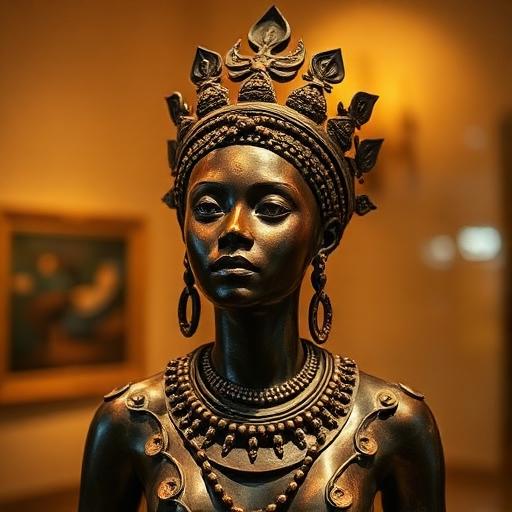
The historical legacy of Queen Nzinga Mbande of Ndongo and Matamba (modern-day Angola) stands as one of the most brilliant counter-strategies against early European colonial expansion. In the 17th century, when the Portuguese mercantile engine sought to destabilize Central Africa through forced extraction and territorial fragmentation, Nzinga responded not merely with military defense, but with masterclass diplomacy, tactical spatial positioning, and a radical restructuring of gender paradigms. Her resistance was a total systemic refusal to allow her people or her land to be reduced to colonial property.
Honoring her legacy is an essential exercise in Sankofa—reaching back into the archive of absolute political brilliance to extract strategic lessons in sovereignty, negotiation, and structural defiance for the modern era.
The Strategic Shift (The Diplomatic Geometry)
[The Ndongo Court]   ──> Mastering Portuguese law and language to negotiate early sovereign treaties
           │
[The Matamba Pivot]  ──> Strategic relocation; conquering Matamba to secure a free, uncompromised trade hub
           │
[The Guerrilla Shield]──> Forming multi-regional alliances to completely disrupt colonial supply lines
Resistance Frameworks: Colonial Submission vs. Nzinga’s Sovereignty
Queen Nzinga’s governance flipped the script on early colonial dynamics, transforming her kingdom from an extracted territory into a formidable political wall.
| Strategic Vector | The Colonial Subjugation Model | Nzinga’s Sovereign Resistance |
| Diplomatic Stance | Enforcing asymmetric treaties designed for land and labor extraction | Negotiating on equal footing; demanding the recognition of territorial borders |
| Spatial Strategy | Enclosing communities and establishing fortified colonial trade ports | Establishing mobile military capitals (kilombos) that adapted to terrain shifts |
| Alliance Matrix | Divide-and-conquer; pitting local groups against one another | Unifying regional forces and partnering with external rivals to isolate occupiers |
| Gender Paradigm | Enforcing strict patriarchal limitations on leadership and statecraft | Fluidly subverting gender roles, ruling directly as King to solidify military command |
The Three Anchors of Sovereign Defiance
-
The Spatial Chair: The legendary diplomatic act where, upon being denied a chair by the Portuguese governor to imply her inferiority, Nzinga commanded her advisor to kneel on all fours, creating a living throne. This refusal to negotiate from a lower physical plane set the structural terms of her sovereignty.
-
The Kilombo Infrastructure: Adopting the kilombo system—a highly disciplined, mobile military and social community template that integrated displaced people and transformed them into an elite, free defense force.
-
The Linguistic Weapon: Mastering the language, religious rhetoric, and legal frameworks of the colonizer, using their own administrative tools to expose their treaty violations on the international stage.
The Spatial Shift
Voices from the Ramparts
“Nzinga understood that colonial warfare was not just fought with muskets, but with symbols, posture, and treaties. When she sat down on equal terms with the governor, she wasn’t just claiming a seat—she was defining African political autonomy for the next four hundred years.”
— Dr. Manuel Neto, Historian of Central African Statecraft
Legacy Performance Metrics
-
Epistemic De-linking: Remembering Nzinga dismantles the false historical narrative that African resistance to early colonialism was passive or disorganized, replacing it with a legacy of complex statecraft.
-
Sovereign Gender Modeling: Her decades-long reign serves as an ancestral blueprint for absolute female political and military leadership, pre-dating modern equity movements by centuries.
-
Territorial Integrity: The geographical lines of her resistance established a historical precedent of unified regional identity, which later served as a foundational inspiration for modern liberation movements in Angola.
