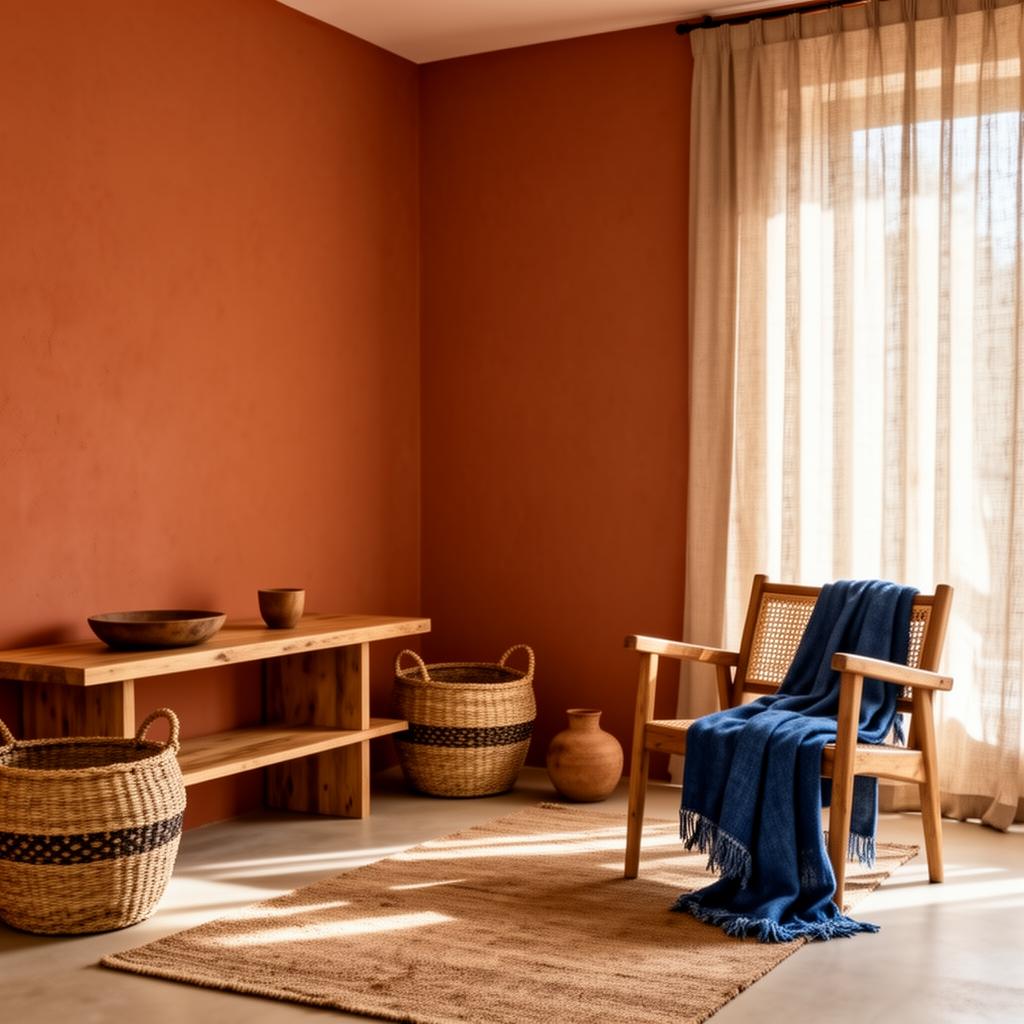
ls that hermetically seal living spaces, trapping stagnant air and artificial toxins. Reversing this trend requires a return to low-impact, elemental components that interact dynamically with the indoor environment. Building with raw, unglazed terracotta creates an interior ecosystem capable of self-regulation, functioning as a porous skin that balances humidity, stabilizes temperature, and softens light.
Integrating this ancient, earth-based material into contemporary architecture embodies the principle of Sankofa—retrieving time-tested, vernacular building materials to engineer healthy, bioclimatic homes for the future.
The Breathable Loop (The Hydrological Cycle)
[Moisture Absorption] ──> Porous terracotta walls pull excess humidity from stagnant air
          │
[Thermal Storage]      ──> Dense clay blocks shift solar heat, keeping spaces cool by day
          │
[Evaporative Release]  ──> As ambient air dries, moisture slowly escapes the clay, cooling the room
Material Systems: Sealed Drywall vs. Breathable Terracotta
Unglazed clay surfaces act as a passive environmental management system, fundamentally differing from standard synthetic wall coatings.
| Architectural Metric | Standard Sealed Drywall | Unglazed Terracotta Elements |
| Air Permeability | Zero; traps volatile organic compounds (VOCs) | High; allows micro-ventilation through cellular pores |
| Moisture Response | Vulnerable to surface mold and condensation buildup | Absorbs and releases airborne moisture dynamically |
| Thermal Performance | Low thermal mass; relies heavily on HVAC systems | High thermal mass; stores and slowly releases heat energy |
| Visual Surface | Flat, synthetic finish reflecting uniform glare | Earthy, textured surface absorbing and diffusing light |
The Three Structural Pillars of Earth-Design
-
The Porous Partition: Utilizing hollow, unglazed terracotta screen blocks (brise-soleil) partitions interior spaces without blocking the natural circulation of air and filtered sunlight.
-
The Low-Fired Floor: Laying hand-pressed terra-cotta tiles over an insulated lime bed creates a floor that remains cool underfoot in summer while acting as a gentle radiant heater during colder cycles.
-
The Raw Plaster Matrix: Coating standard backing walls with a thick layer of natural clay and shredded straw plaster provides an additional layer of non-toxic insulation that actively filters airborne particles.
The Spatial Shift
Perspectives on the Earth
“We have spent decades building houses that act like plastic bags, and then we wonder why our indoor air makes us sick. Returning to terracotta isn’t a step backward into primitive living; it is a sophisticated step forward into biological architecture.”
— Clara Mensah, Sustainable Materials Engineer
Environmental Performance Metrics
-
Passive Humidity Stabilization: Rooms lined with a significant volume of exposed, unglazed clay maintain a stable indoor humidity level between 40% and 60%, the optimal zone for human respiratory health.
-
Industrial Decarbonization: Specifying locally dug, sun-dried, or low-fired clay elements instead of heavily processed gypsum and synthetic paints dramatically lowers the initial embodied carbon footprint of an interior fit-out.
-
Acoustic Softening: The microscopically irregular, porous surface of unglazed terracotta dampens sharp sound frequencies, significantly reducing echo and ambient noise pollution within open-plan layouts.
